
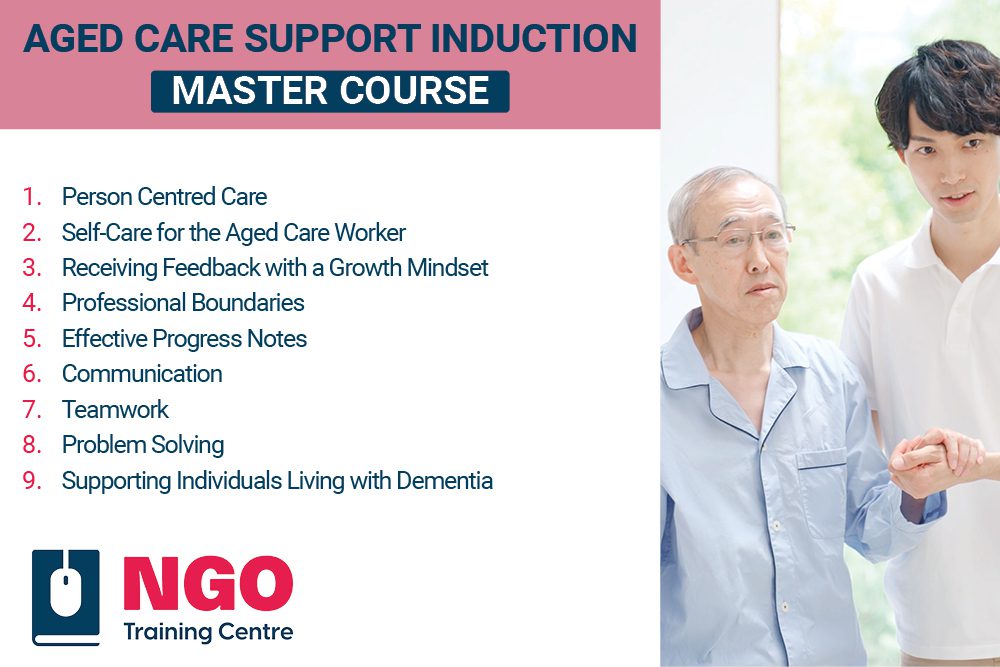
Aged Care Support Induction Pathway
Original price was: AU$422.00.AU$338.00Current price is: AU$338.00.
Course Duration: 5 hrs
Accessible for: 279 days
The Aged Care Support Induction Pathway combines 9 essential modules to provide foundational induction training for aged care workers, building key skills for professional, compassionate, and compliant support in line with the strengthened Aged Care Quality Standards and the Aged Care Act.
You will cover:
- Person-centred care: Core principles, alignment with standards and legislation, worker responsibilities, and scenario-based application of choice, dignity, respect, and independence.
- Self-care for workers: Six essential domains and creating a personalised Self-Care Plan to support health and well-being.
- Receiving feedback with a growth mindset: Understanding feedback’s purpose, using it for growth, and celebrating positive outcomes.
- Professional boundaries: Defining and maintaining boundaries, handling relationship dynamics with ageing individuals, recognising risks, and preventing crossings/violations.
- Effective progress notes: Purpose, components, professional language, legal significance, compliance with the Aged Care Act, Quality Standards, and AN-ACC funding.
- Communication in aged care: Best practices for verbal/written communication, body language, and using common aids to build stronger connections.
- Teamwork in aged care: Defining strong teams, leveraging diverse skills, managing conflicts through communication, and the complete-collaborate-compromise process.
- Problem-solving in aged care: Definition, key stages, practical implementation, and tools/techniques for daily use.
- Supporting individuals living with dementia: Understanding dementia (causes, risk factors, symptoms, brain changes), best-practice support approaches, multidisciplinary roles, and key resources.
This pathway equips aged care workers with practical tools, professional behaviours, and evidence-based strategies to deliver safe, respectful, high-quality care while prioritising personal well-being, teamwork, and regulatory compliance in residential and home care settings.
After this lesson you will be able to:
- Person Centred Care in Aged Care
- Identify the core principles of person-centred care in aged care settings and explain their importance in supporting individuals.
- Describe how person-centred care aligns with the Strengthened Aged Care Quality Standards and identify its role in improving aged care practices.
- Explain how the new Aged Care Act supports person-centred care and outline the aged care worker’s responsibilities in applying it.
- Analyse practical examples, using key principles to create effective, individualised care plans.
- Self Care for the Aged Care Worker
- Explain what Self-Care is and why it is so important.
- Identify the six key areas of Self-Care.
- Outline what factors contribute to good health and well-being.
- Develop and use your Self-Care plan to enhance your health and well-being.
- Receiving Feedback with a Growth Mindset in Aged Care
- Explain the purpose and importance of feedback
- Use feedback for your own personal growth
- Recognise and celebrate positive outcomes
- Professional Boundaries in Aged Care
- Describe boundaries and the differences between professional and personal relationships.
- Explain how to create strong professional boundaries as an aged care worker.
- Identify the risks and early warning signs associated with boundary crossings or violations.
- Effective Progress Notes in Aged Care
- Explain what a progress note is and why they are used
- Describe the key components of an effective progress note
- Identify the language that should be used when writing a progress note
- Recognise the legal requirements and considerations for writing effective progress notes
- Communication in Aged Care
- Define and explain effective communication.
- Describe best practices for effective written and verbal communication.
- Understand how a person’s body language influences communication.
- Recognise some communication aids you will encounter as an aged care worker.
- Teamwork in Aged Care
- Define a team
- List the 5 attributes of a successful team member
- Explain what makes a successful team
- Describe how to manage conflict effectively
- Problem Solving in Aged Care
- Define problem-solving.
- Describe the stages of problem-solving.
- Demonstrate how problem-solving can be applied in your role as an aged care worker.
- Use problem-solving tools and techniques effectively.
- Supporting Individuals Living with Dementia in Aged Care
- Understand what dementia is, including its risk factors, signs, symptoms, and effects
- Know how dementia impacts brain anatomy
- Identify how dementia is diagnosed and the ten various types of dementia
- Implement best-practice approaches to supporting an ageing individual living with dementia
- Identify the multidisciplinary support team, and articulate the role of the aged care worker
E-learn (5 hrs)
- Person Centred Care in Aged Care
- E-learn (40 min)
- 3 Resources
- Transforming-aged-care-for-aboriginal-and-torres-strait-islander-people.pdf
- Support-at-home-program-handbook.docx
- Video Person Centred Care 2025
- Certificate of completion
- Self Care for the Aged Care Worker
- E-learn (30 min)
- 4 resources:
- The Complete Guide to Progress Notes
- The language we should use when writing a progress note
- SIRS – Unexpected Death Fact Sheet
- Australian National Aged Care Classification (AN-ACC) funding model
- Certificate of completion
- Receiving Feedback with a Growth Mindset in Aged Care
- E-learn (35 min)
- Certificate of completion
- Professional Boundaries in Aged Care
- E-learn (30min)
- 2 resources:
- Personal vs Professional Relationships
- Boundary crossing poster
- Certificate of completion
- Effective Progress Notes in Aged Care
- E-learn (35min)
- 4 resources:
- The Complete Guide to Progress Notes
- The language we should use when writing a progress note
- SIRS – Unexpected Death Fact Sheet
- Australian National Aged Care Classification (AN-ACC) funding model
- Certificate of completion
- Communication in Aged Care
- E-learn (39min)
- 2 resources:
- Communication Checklist – A self-reflection communication questionnaire
- Effective Communication poster
- Certificate of completion
- Teamwork in Aged Care
- E-learn (25 min)
- Certificate of completion
- Problem Solving in Aged Care
- E-learn (30min)
- 1 resource:
- Problem Solving Skills worksheet
- Certificate of completion
- Supporting Individuals Living with Dementia in Aged Care
- E-learn (40min)
- 7 Resources:
- Dementia Facts and Figures
- The Power of words and insight: caring for people living with dementia
- Types of Dementia
- Carer’s Gateway Factsheet
- Dementia Australia
- Building Connections with People Living with Dementia
- Dementia Resources
- Certificate of completion
You must be logged in to post a review.
Check out these related courses
-
Sale!
Assisting Individuals with Medication Bundle
(4)Original price was: AU$98.00.AU$78.00Current price is: AU$78.00. Select options This product has multiple variants. The options may be chosen on the product page -
Medication Assistance and Administration Pathway
(2)AU$247.00 Select options This product has multiple variants. The options may be chosen on the product page -

The Strengthened Aged Care Quality Standards – Part 2
(6)AU$49.00 Select options This product has multiple variants. The options may be chosen on the product page



Reviews
There are no reviews yet.