There’s less time than the calendar suggests…
Somewhere in Australia right now there is a person sitting in their home office with a laptop open and a cup of coffee going cold beside it. They have an ABN. They have a logo they built at eleven o’clock one night. They have a folder of policies they found from a template, downloaded, lightly skimmed, mostly believed. They have 10 support staff actively supporting participants accessing the scheme, and demand just keeps growing. They think the hard part is behind them.
It is not. But the work is learnable, and they have a little time – though less than the calendar might suggest.
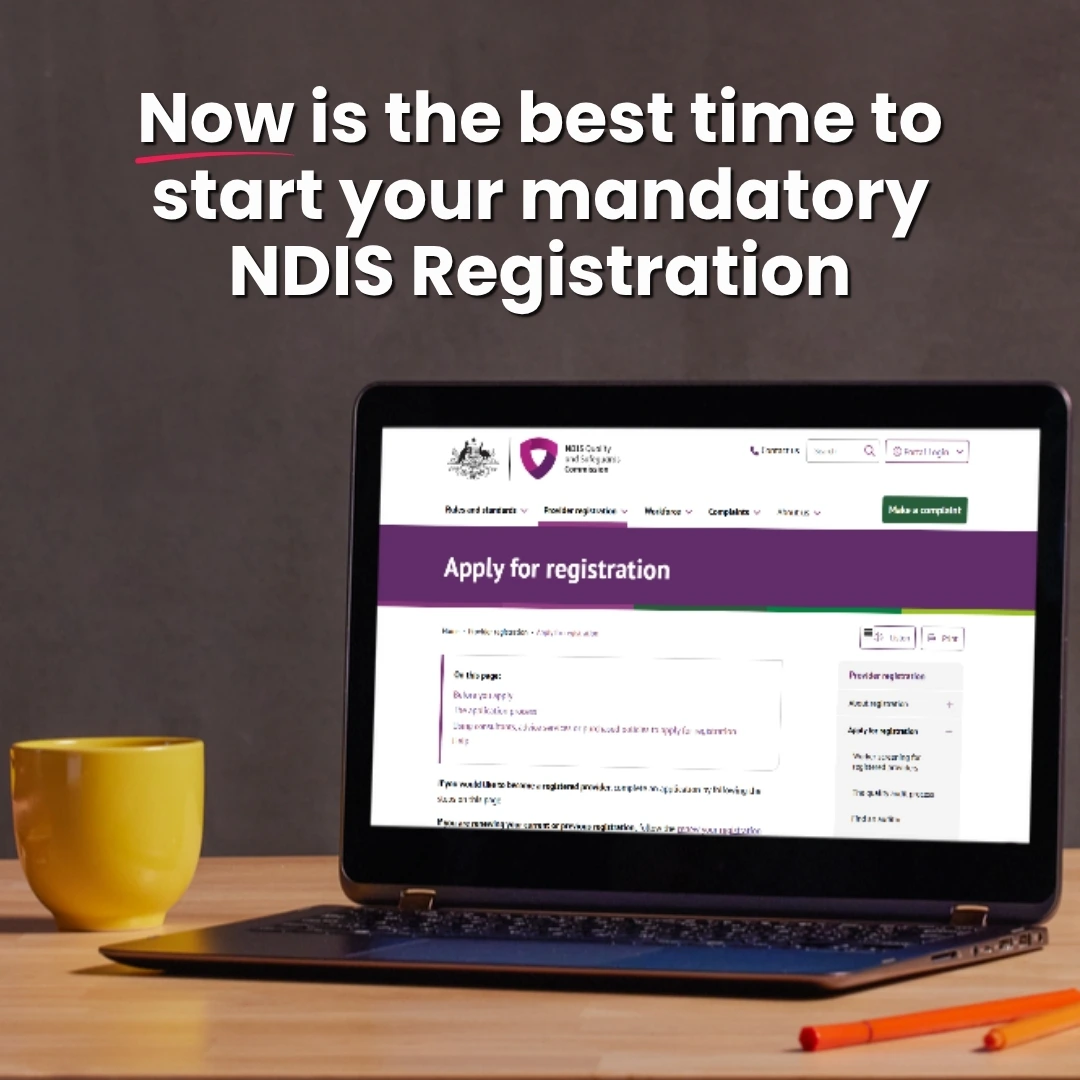
In December 2025, the Minister for the NDIS confirmed that supported independent living (SIL) providers and platform providers must register with the NDIS Quality and Safeguards Commission. That requirement starts on 1 July 2026. From that date, SIL and the relevant digital platforms move from “register if you feel like it” to “register, full stop”.
Now the part everyone wants pinned down: how long do you have?
The honest answer is that the Commission has not locked the final transition end date. Providers already delivering SIL without registration will not need to be fully registered on the morning of 1 July 2026. There is a transition period, and the Commission has said it will hand down the staged arrangements and further guidance as they are confirmed.
That sounds generous. It’s really not, and here’s why.
SIL sits on the Certification pathway. That means a two-stage audit – a documentation review, then an on-site audit against the NDIS Practice Standards, including the new SIL-specific standards. From start to finish, Certification takes eight to twelve months for a provider who is organised and arrives without major problems. Auditors are a finite resource. Every provider racing the same deadline lines up in the same queue, and the queue only tightens as the date gets closer.
So, the real answer to “how long do I have?” is not “until the transition ends”. It is “long enough, if you start now and not long at all, if you wait.”
A note for everyone reading this from the sidelines: certain it does not apply to them. In April 2026, the government made another HUGE announcement. It announced that mandatory registration will expand to cover personal care, daily living supports, and supports delivered in closed settings, with the expansion expected to commence from July 2027, with details still to be confirmed. If you deliver one of those supports, your turn is coming, and the same arithmetic applies.
The part that catches most providers out
The piece of this that trips up good providers is the self-assessment.
When you apply, you assess your own organisation against the NDIS Practice Standards. In writing. With evidence behind every claim. This is where capable services come unstuck, not because the support they deliver is poor, but because nobody has shown them what a quality response looks like or what evidence the Commission expects to see beneath it. Nearly one in four registration applications were rejected in a single year. A common reason was generic, template-style responses. There is a task force whose job is to spot exactly that.
A rejection is not a gentle tap on the wrist. It can stall the services you wanted to deliver, cost real money in fees and reapplication, and tarnish a reputation you have only just started building.
What the NGO Training Centre can offer
The NDIS Practice Standards are made up of a core module and a set of supplementary modules that apply depending on what you deliver.
Our NDIS Self-Assessment Preparation Courses are built the same way, so you pick only the ones relevant to your registration. Each course explains what the standard actually requires, shows you what a strong response reads like, and tells you the kind of evidence you need to support it. They run between twenty and sixty minutes, on a computer, tablet or phone, whenever it suits you.
They are built for people applying for the first time, for registered providers preparing for audit, and for practitioner roles such as behaviour support practitioners.
If you want to understand the shape of the thing before you spend a cent, start with the free introductory course. It walks through the registration application process, and what the self-assessment involves, so you go in knowing the terrain rather than guessing at it.
An auditor, Marguerite Hoiby, put it clearly in her review below. When the people who audit you say the preparation is worth doing, that is worth a pause.

“The Introduction course is highly comprehensive, simple, straightforward with some very helpful tips and hints. Worthwhile for any new providers.”
– Marguerite Hoiby, NDIS Auditor
A SIL module is on the way
For the providers reading this with 1 July 2026 already circled, a dedicated SIL module is in the works and will be released in the near future, built around the new SIL-specific Practice Standards.
If SIL is your world, keep an eye out for it here on our website.
What next?
Getting registered is the start. Staying registered means staying compliant, and compliance was never a one-person job. I strongly advise you to outsource your training to ensure your staff receive the most up-to-date training and easily accessible evidence that auditors just froth over.
Our full course suite is built so the whole organisation stays trained and compliant across the areas it actually services. This ranges from frontline staff and management all the way to the board. Audit readiness is not a sprint at a deadline. It should be the norm. If you are a regular reader of my articles, you may remember one of my previous pieces in which I mention my own mantra as a former Quality Assurance Manager for a Disability Advocacy Organisation: ‘ARFA’, or ‘Always Ready For Audit’.
Which brings us back to the kitchen table, and the coffee that is now ice-cold.
The person sitting there was never going to be undone by the ‘work’. They were only ever at risk of being surprised by it. Surprise is the expensive part. Preparation is the cheap one.
Be ahead of the game. Don’t wait until it’s too late.
It’s my best piece of advice for you.
Get the guidance you need to succeed.
Start today with our FREE NDIS Self-Assessment Introductory Course.
Then, complete the supplementary courses relevant to your registration, and you’ll be well on your way to NDIS Registration!
Not ONLY do we provide these great courses, but we also have over 100 disability-specific, fully NDIS-compliant microlearning courses you can access starting at only $29 per staff member per year. All providers, including Allied Health and Support Coordinators, can also access our bundles or pathways that can be purchased online if you need very specific training or to fill any gaps in your current training.
You can talk to us about all of your options by contacting our friendly and supportive team using the form below, or at 1300 990 995.
We want to ensure that you are not left behind when these changes are implemented. The disability community needs you!
–
Author: Amanda Robinson BA, MMHealthPrac,
As Head of Learning and Development and a seasoned NDIS expert, Amanda drives capability and sustainability in the disability and health sectors. With over 15 years of experience, post-graduate qualifications in Mental Health Leadership and Management, and currently pursuing an MBA, she brings deep expertise and personal insight as someone with lived experience of disability. A devoted carer, Amanda champions Human Rights, working to dismantle stigma and barriers for individuals with disability and mental health challenges. She is passionate about building robust stakeholder relationships, leveraging her advocacy, communication, strategic thinking, and analysis skills.