Meta Pixel

The National Disability Insurance Agency (NDIA) has unveiled changes to the National Disability Insurance Scheme (NDIS) pricing, in anticipation of broader reforms aimed at strengthening the NDIS provider market. However, there may be a few disappointed providers with no changes for plan management, therapy or Support Coordination (L 2&3).

Here’s a summary of the changes for you:

  • Fair Work Commission Adjustments: Fully implementing the Fair Work Commission’s decision to increase minimum wages in awards and superannuation, ensuring providers can fairly compensate their workers.
  • Price Limit Increases: Raising price limits for supports determined by the NDIS Disability Support Worker (DSW) Cost Model, including Level 1 support coordination services, to reflect changes in minimum wages following the Fair Work Commission’s Annual Wage Review.
  • Support Adjustments: Increasing price limits for psychologists, nurses, and other supports based on the rise in wages and the cost of living.
  • Maintaining Existing Price Limits: Keeping existing pricing arrangements and price limits for therapy (except for psychologists) and support coordination levels 2 and 3.
  • Short-Notice Cancellation Adjustment: Adjusting the short-notice cancellation period for non-Disability Support Worker-related supports to 2 business days to better reflect market norms.

We have listed links to each addendum reflecting changes for ease of reference:

Bereavement Addendum 

COVID Addendum 

Assistive Technology, Home Modifications and Consumables Code Guide

The Assistive Technology, Home Modifications and Consumables Code Guide lists the most commonly used supports.

Pricing Arrangements for Specialist Disability Accommodation

Pricing arrangements for SDA can be found on the SDA pricing and payments page.

Disability Support Worker Cost Model

The cost model estimates the expenses involved in providing one billable hour of support, factoring in all related costs. Fortunately, the NDIS Disability Support Worker Cost Model has been updated to more accurately represent the cost structures of efficient providers in the sector. This updated model forms the foundation for the price limits set by the NDIA for services provided by disability support workers.

The plans of NDIS participants will be adjusted starting in July, with funding being indexed on 13 July to account for these pricing changes.

You can find a copy of the price guide here: https://www.ndis.gov.au/media/7151/download?attachment

Written by Amanda Robinson, B.A., MMentalHealth Prac.

Amanda is a professional with over a decade of dedicated experience in the fields of Mental Health and Disability. Her extensive expertise lies in navigating the intricate landscape of the Disability Sector. She brings a unique perspective to her work, being both a person with lived experience of disability and a compassionate carer. She has a passion for advocacy, making her a staunch champion for the rights and well-being of individuals facing similar challenges.

Yesterday, the National Disability Insurance Scheme Amendments (Getting the NDIS Back on Track No. 1) Bill passed through the House of Representatives. It will now go on to be considered in the Senate. The Bill included important changes that were agreed upon by the Parliament.

You can find more details about these changes on the Parliament of Australia’s website and the Department of Social Services’ website under “Changes to the NDIS Act” (dss.gov.au). If you’d like to get into the details, visit https://shorturl.at/2qJIl but here is a summary of those changes:

  • Section 10 now mentions Australia’s overall responsibilities under the Convention on the Rights of Persons with Disabilities instead of specific articles.
  • New temporary NDIS rules will define what supports are or aren’t NDIS supports, based on current agreements and existing rules from 2013.
  • These temporary rules will be made with input from the disability community and will later be replaced by new rules that need State and territory approval.

Other supported changes to the Bill will:

  • Highlight that co-design is central to the Government’s reform plans.
  • Confirm that participants’ rights to review remain unchanged.
  • Ensure participants receive a copy of their needs assessment.
  • Provide safeguards for new information-gathering powers.
  • Include an independent review of the Bill every 5 years.

Let’s hope these changes continue to reflect the government’s commitment to the principles of co-design, ensuring that the NDIS is shaped by those most affected by it – people with Disability, their families and supporters.

Written by Amanda Robinson, B.A., MMentalHealth Prac.

Amanda is a professional with over a decade of dedicated experience in the fields of Mental Health and Disability. Her extensive expertise lies in navigating the intricate landscape of the Disability Sector. She brings a unique perspective to her work, being both a person with lived experience of disability and a compassionate carer. She has a passion for advocacy, making her a staunch champion for the rights and well-being of individuals facing similar challenges.

The Department of Social Services has created a Q&A page regarding the NDIS Amendment Bill which may answer some of your burning questions.
As you may have seen, whilst providers wait with bated breath, there has been a significant uproar from the disability community about these proposed changes, and the lack of involvement and consultation with the disability community.

Bill Shorten has released a new video series which busts some of the myths about NDIS reforms.

Mr Shorten chatted with Elly Desmarchelier – a disability advocate and brilliant speaker on disability and the NDIS.

Their first videos are live and linked here:

👉 https://www.youtube.com/watch?v=rdU3Brh-OMA

👉 https://www.youtube.com/watch?v=IhbzGU6q9Jg

Be sure to keep updated about these changes and the key concepts within the Bill and the proposed changes.

There is also an upcoming event that you may not want to miss:

Minister Shorten will be answering questions online at an NDIS Community Catch Up on Wednesday 5 June at 4:00 pm (AEST).

Register here: https://events.humanitix.com/ndis-reform-community-catch-up-online

Join online to ask your questions.

Details are available at www.dss.gov.au/NDISreforms

Easy read available to view here.

Accessibility:

  • Auslan –  Auslan interpreter will be available.
  • Closed captioning – Will be available.

Timezone support:

If you are joining virtually from a different state here are the start times in your local timezone.

  • WA: 2:00 pm
  • NT: 3:30 pm
  • SA: 3:30 pm
  • NSW, VIC, Tasmania, ACT: 4:00 pm

We will continue to keep you updated! Follow us and connect for any updates!


Written by Amanda Robinson, B.A., MMentalHealth Prac.

Amanda is a professional with over a decade of dedicated experience in the fields of Mental Health and Disability. Her extensive expertise lies in navigating the intricate landscape of the Disability Sector. She brings a unique perspective to her work, being both a person with lived experience of disability and a compassionate carer. She has a passion for advocacy, making her a staunch champion for the rights and well-being of individuals facing similar challenges.

On May 22nd, the vibrant city of Gold Coast hosted a lovely evening of networking, drinks, and nibbles, featuring esteemed leaders from across Australia.

The CEO of NGO Training Centre, Jasminne Hristic, was among the distinguished panelists invited to join the ONE COMMUNITY team for this special occasion.

The event provided a unique platform for growth-minded leaders to engage in stimulating discussions and share insights on leadership. Jasminne Hristic, known for her innovative approach and dedication to empowering non-profit organisations, contributed to the evening’s dynamic conversations. Her interactions with other attendees were not only inspiring but also paved the way for potential collaborations aimed at driving impactful change in the community.

The evening was proudly sponsored by Astalty NDIS Software, whose support made this gathering possible. Their commitment to fostering environments where leaders can connect and grow aligns perfectly with the goals of ONE COMMUNITY and the NGO Training Centre.

Overall, the event was a resounding success, leaving attendees with fresh perspectives and renewed motivation to lead with purpose and vision.

We hope to see many more from ONE COMMUNITY and their amazing sponsors in the future!

Written by Amanda Robinson, B.A., MMentalHealth Prac.

Amanda is a professional with over a decade of dedicated experience in the fields of Mental Health and Disability. Her extensive expertise lies in navigating the intricate landscape of the Disability Sector. She brings a unique perspective to her work, being both a person with lived experience of disability and a compassionate carer. She has a passion for advocacy, making her a staunch champion for the rights and well-being of individuals facing similar challenges.
In light of the release of the 2024-2025 budget, the Albanese Labor Government is enhancing support for Australians with disabilities through increased investment in disability employment and the NDIS.

Here is a breakdown for you:

Key Initiatives:

Specialist Disability Employment Program:

  • Funding: An additional $227.6 million, totalling $5.4 billion over five years.
  • Launch: Starting July 1, 2025.
  • Goals: Improve employment opportunities, provide tailored supports, and introduce a single wage subsidy up to $10,000.

Disability Employment Centre of Excellence:

  • Funding: $23.3 million over four years.
  • Purpose: Enhance service quality and share best practices among employment service providers.

NDIS Evidence Advisory Committee:

  • Funding: $45.5 million over four years, plus $13.3 million annually ongoing from 2024-25.
  • Role: Offer independent advice on effective therapeutic supports to ensure evidence-based and cost-effective NDIS funding.

National Disability Abuse and Neglect Hotline and Complaints Resolution and Referral Service:

  • Funding: An additional $2.6 million.
  • Function: Provide confidential channels for reporting abuse and raising concerns about disability services.

What does this mean for you?

These initiatives are part of a broader commitment to ensure high-quality, inclusive support for people with disability, based on findings from the Royal Commission and the independent NDIS review. As we receive more information, we will share this with you.

To read the full media release and for further details, visit: https://ministers.dss.gov.au/media-releases/14656

Written by Amanda Robinson, B.A., MMentalHealth Prac.

Amanda is a professional with over a decade of dedicated experience in the fields of Mental Health and Disability. Her extensive expertise lies in navigating the intricate landscape of the Disability Sector. She brings a unique perspective to her work, being both a person with lived experience of disability and a compassionate carer. She has a passion for advocacy, making her a staunch champion for the rights and well-being of individuals facing similar challenges.
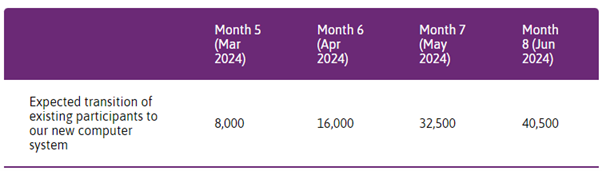
 

The NDIA is gradually bringing in their new computer system and better processes all over Australia.

Providers can start getting ready to switch to the new methods whenever they want, and most have probably already commenced.

To help everyone prepare, they have shared some data about how many NDIS plans they expect to approve in their new system over the next few months:

Providers will switch to the new methods, including the new My NDIS provider portal, when the participants they support have NDIS plans in the new system. The NDIA has stated that they will let participants know which system their plan is in so that they can share this info with their providers.

Claims should still be sent through the current myplace provider portal, no matter which system a participant’s plan is in.

Starting from October 30, 2023, the NDIA has been working with participants to make their next plan in the new system. This applies to participants whose plan is expiring and they need a new one or want a change to their plan.

All expiring NDIS plans will eventually move to the new system. Participants with plans that work well for them might be offered to keep their current plan for now, and the NDIA will make their next plan in the new system at a later date.

There are other ways providers will know when participants have plans in the new system, like checking the NDIS website’s FAQ section.

Visit the FAQ section for more information.

Key points

  • The NDIA are gradually introducing our new computer system and processes across Australia. They started the gradual rollout on 30 October 2023.
  • The NDIA are taking a careful approach to introducing the new system to make sure everything goes smoothly.
  • The NDIA expect the rollout to take up to 18 months.

Written by Amanda Robinson, B.A., MMentalHealth Prac.

Amanda is a professional with over a decade of dedicated experience in the fields of Mental Health and Disability. Her extensive expertise lies in navigating the intricate landscape of the Disability Sector. She brings a unique perspective to her work, being both a person with lived experience of disability and a compassionate carer. She has a passion for advocacy, making her a staunch champion for the rights and well-being of individuals facing similar challenges.
 

📣 Calling all people with living experience, families, carers and supporters.

🧩 The Australian Government has officially unveiled the Draft version of the National Autism Strategy.

This comprehensive document outlines proposed measures to better support Autistic people throughout various stages of life. Seeking to ensure inclusivity and effectiveness, the government actively seeks public input until May 31st.

Your perspectives and insights are crucial in shaping this strategy to adequately address the diverse needs of autistic individuals across the lifespan.

Accessible versions of the draft strategy, including an Easy Read format, can be accessed via the DSS Website.

To contribute your thoughts and feedback, you can either send an email or participate in a survey that can be accessed via the Developing the National Autism Strategy Page. 

The final version of the strategy is due for release later in 2024, with the collective input of stakeholders playing a pivotal role in its development.

Please provide your feedback today!


Written by Amanda Robinson, B.A., MMentalHealth Prac.

Amanda is a professional with over a decade of dedicated experience in the fields of Mental Health and Disability. Her extensive expertise lies in navigating the intricate landscape of the Disability Sector. She brings a unique perspective to her work, being both a person with lived experience of disability and a compassionate carer. She has a passion for advocacy, making her a staunch champion for the rights and well-being of individuals facing similar challenges.
Society must recognise that everyone should have the autonomy to make choices about their own lives.

When someone requires support to make decisions, employing supported decision-making is key to preserving a person’s independence and rights.

At NGO Training Centre, we are soon releasing a course on Supported Decision Making that will be a game-changer for many Disability Support Professionals.

But what about participants who have other formal decision-makers in place?

If a Guardian or Administrator is appointed for an individual, you must still safeguard their fundamental rights as outlined in the UN Convention on the Rights of Persons with Disabilities.

In this article, I am going to give you a brief outline of Powers of Attorney, Plan and Correspondence Nominees (NDIS), Guardianship and Administration.

As an advocate, I had service providers regularly approach me who were confused about working with a participant who had a guardianship or administration order in place and what this meant for the participant, and them as a provider.

Hopefully, this sheds some light on this issue, but keep in mind that laws and regulations vary in each state and territory. Having practised as an advocate in both QLD and Victoria, I found that there were marked differences in processes and even the frequency of, and rules around guardianship and administration.

Powers of attorney

If you are working with a participant who needs help managing their affairs, they can choose to give someone they know and trust, or a specialist organisation (such as the Public Trustee and Guardian in NSW) the power to make decisions for them. This will allow someone else to manage their affairs when they do not want to or are no longer able to.

Depending on their situation, this may include:

  • the power to make decisions about their financial and legal affairs
  • decisions about their lifestyle (including where they live), their support and what medical or health treatment they should receive.

If a person that you are supporting has an order in place and a decision-maker appointed, it does not mean that they can make decisions about every aspect of the participant’s life. It’s important to check the order to see what reason(s) the guardian/administrator has been appointed.

Plan and correspondence nominees

A plan nominee is someone appointed, in writing, to act on behalf of an NDIS participant.

This could be at the participant’s request or at the request of the NDIA when there are no other less restrictive options.

A plan nominee has a duty to:

  • ascertain the wishes of the participant
  • act in a manner that promotes the personal and social well-being of the participant
  • only act if the participant is not capable of doing the act
  • develop the capacity of the participant
  • avoid or manage conflicts of interest.

Another type of nominee that can be appointed is a correspondence nominee.

A correspondence nominee is someone who can make some decisions for a participant about their business with the NDIS. But they can’t do anything or make decisions about:

  • preparing or changing a plan
  • managing the funding for supports in a plan.

If a participant needs someone to make decisions for them about their plan, they may need a plan nominee.

A correspondence nominee can ask the NDIA for information about a participant on their behalf. They can also opt to receive letters and notices.

You can find more information about Plan and correspondence nominees here: Appointing a Nominee

Guardianship and Administrators

If a participant has not formally appointed someone to manage their affairs (under a power of attorney) and it becomes necessary to do so, a guardianship board or tribunal may appoint a guardian and/or administrator on behalf of a participant.

I will define the two main types of appointed decision-makers.

*Note that Some states have variations of these, such as supportive guardians and supportive administrators (Vic).

A Guardian (who could be a family member or friend), is a substitute decision-maker who may make lifestyle decisions, such as where the participant should live, and the support they receive, as well as give their consent to medical, dental and health care services generally.

An Administrator acts as a financial manager and looks after a person’s property and finances. If no individual is appropriate for this, a state or public trustee service is often appointed to manage a person’s finances.

There are several factors that the guardianship board or tribunal will take into account before deciding to appoint a guardian or administrator, including:

  • The participant’s ability to manage their own affairs
  • any relevant medical or health conditions that might affect their ability to make decisions – such as dementia, intellectual disability, mental illness, or acquired brain injury
  • whether it is in their best interests to have a guardian or administrator appointed.

The rules are different in each state and territory, so it is important to contact the relevant authority where you live for details on the guardianship and administration laws in the relevant state or territory, or if you have any questions or concerns about an order.

Refer to the authorities listed below:

An advice or advocacy agency may also be able to assist, and you can find them here: https://askizzy.org.au/


Written by Amanda Robinson, B.A., MMentalHealth Prac.

Amanda is a professional with over a decade of dedicated experience in the fields of Mental Health and Disability. Her extensive expertise lies in navigating the intricate landscape of the Disability Sector. She brings a unique perspective to her work, being both a person with lived experience of disability and a compassionate carer. She has a passion for advocacy, making her a staunch champion for the rights and well-being of individuals facing similar challenges.
The Albanese Government is making changes to the National Disability Insurance Scheme (NDIS) to help those who need it most and to ensure the NDIS works as originally intended.

Yesterday, a new bill was introduced to Parliament, called the National Disability Insurance Scheme Amendment (Getting the NDIS Back on Track No. 1) Bill 2024. This fulfils a promise made earlier to make these changes by the first half of 2024.

The goal of this bill is to improve the NDIS so it can keep changing lives for Australians with disabilities. It aims to ensure the money in the NDIS goes to the people who need it, and it gives more power to the NDIS Quality and Safeguards Commission to protect participants from experiencing exploitation.

These changes come after an independent review of the NDIS, consultations with states and territories, and discussions with people with disabilities and the sector.

The main areas this bill focuses on are improving access, plans, budget settings, and quality and safety.

In summary, the bill aims to make the following changes:

  • They want to change how they decide who gets support from the scheme. Instead of just focusing on diagnoses, they’ll look at what people actually need. This could mean less paperwork for people with disability because they won’t have to keep proving they have a disability.
  • Also, they might give people plans that last longer, up to five years, and let them have more control over how they spend their support money.
  • They’re working on making a clear definition of what “NDIS support” means so that money is spent properly. They’re looking at international guidelines to help with this.
  • They’re thinking about giving the NDIS agency more power to deal with financial risks, like fraud, and they might make the watchdog commission that oversees the scheme bigger to make sure it’s working well.

The Minister for the NDIS, Bill Shorten MP, says these reforms will take time and they’re committed to working with the disability community to make sure the changes happen the right way.

While some improvements won’t happen immediately, the government will keep working with the disability community to make sure the NDIS works well for everyone.

This bill is part of a larger effort to return the NDIS to its original purpose and create better support for people with disabilities across Australia. Last year, we summarised the NDIS Review, which you can find on our In the News page.

The government has already invested $130 million this year for consultation and co-design, but there’s still a lot of work to be done to make these reforms a reality.

They’re encouraging people to stay informed and engaged through their website and to reach out if they have any questions or need support.

Watch this space for further updates!

For more information on the bill, visit www.dss.gov.au/NDISreforms

More information about the NDIS Review is available on the NDIS Review website.

Subscribe for their updates about coming engagement opportunities at www.dss.gov.au/disability-and-carers

You can find a great Easy Read resource here: Easy Read Resource

To contact the department, you can email them at [email protected] or call 1300 653 227 Monday to Friday between 8.30am and 5pm (AEDT). If you are Deaf or have a hearing or speech impairment, you can use the National Relay Service to contact the department.


Written by Amanda Robinson, B.A., MMentalHealth Prac.

Amanda is a professional with over a decade of dedicated experience in the fields of Mental Health and Disability. Her extensive expertise lies in navigating the intricate landscape of the Disability Sector. She brings a unique perspective to her work, being both a person with lived experience of disability and a compassionate carer. She has a passion for advocacy, making her a staunch champion for the rights and well-being of individuals facing similar challenges

In a move against exploitation, the federal government has initiated a crackdown on illegal overcharging within the National Disability Insurance Scheme (NDIS).

Led by the Australian Competition and Consumer Commission (ACCC), this crackdown targets providers who unjustly inflate prices, dubbing it the “NDIS ‘wedding tax’,” levied solely because an individual is part of the NDIS.

NDIS Minister Bill Shorten has pledged to expose dishonest practices, vowing to eliminate “shonky” providers who exploit individuals with disability, some of whom have gained significant wealth through taxpayer-funded disability services.

The Australian Criminal Intelligence Commission estimates that up to a fifth of NDIS expenditure is siphoned off through fraudulent means.

To empower participants and their support networks, Minister Shorten announced the distribution of letters outlining their rights and avenues to combat overcharging.

Bill Shorten stated “The era of exploiting disabled individuals within the NDIS is unequivocally over.” Amendments to NDIS regulations expressly forbid overcharging, with further legislative measures underway to reinforce this prohibition and impose severe penalties.

Under the new regime, consumers can report instances of overcharging to a dedicated task force, which will investigate complaints and take action where necessary. Although the ACCC typically does not handle individual price grievances, the updated code of conduct for NDIS providers mandates fair pricing practices, enabling the consumer watchdog to intervene in cases of unjustifiable price hikes.

Individuals can reach out to the NDIS price taskforce via email at [email protected] or by calling 1800 035 544.

Providers found in violation face financial sanctions, permanent exclusion from NDIS services, and potential criminal charges for fraudulent activities.

Marayke Jonkers, president of People With Disability Australia (PWDA), expressed confidence that these measures will ensure NDIS participants receive fair value for services rendered. “These changes mark the end of discriminatory pricing based solely on NDIS affiliation while holding providers accountable for ethical conduct,” remarked Ms. Jonkers.

Important takeaways:

  • Providers suspected of overcharging NDIS participants will face a new consumer watchdog task force.
  • As much as a fifth of NDIS spending is being rorted by exploitative providers, the Criminal Intelligence Commission has warned.

What’s next? The ACCC will begin investigating complaints made by participants and carers from Sunday 24th March 2024.

Written by Amanda Robinson, B.A., MMentalHealth Prac.

Amanda is a professional with over a decade of dedicated experience in the fields of Mental Health and Disability. Her extensive expertise lies in navigating the intricate landscape of the Disability Sector. She brings a unique perspective to her work, being both a person with lived experience of disability and a compassionate carer. She has a passion for advocacy, making her a staunch champion for the rights and well-being of individuals facing similar challenges.
 

NGO Training Center Online NDIS learning
Trigger Sidebar Cart0
×
Your cart is empty. Return Home