
Meta Pixel

On 20 August 2026, the government confirmed that the Commonwealth Home Support Programme (CHSP) will keep operating in its current form until at least 30 June 2029.

What does it mean for Home Care Providers?

After two years of uncertainty, home support providers finally have an answer.

On 20 August 2026, the government confirmed that the Commonwealth Home Support Program (CHSP) will keep operating in its current form until at least 30 June 2029. The plan to fold CHSP into Support at Home has been put on hold. For the roughly 1,300 organisations delivering these services, the program they depend on is staying for now.

The merger was expected no earlier than July 2027, and the prospect had shaped provider decisions for some time. Services held off on hiring, deferred investment, and in some cases stepped back from delivery altogether because they could not see a stable future. Several local councils said uncertainty directly led them to withdraw from CHSP. I personally know of two important services here in the Loddon-Mallee, VIC that relinquished their funding because of the proposed changes and uncertainty about the future of funding under their service categories.

At least now, a little late for some, the extension removes the immediate cause of that hesitation and gives providers a firm horizon to plan against.

CHSP Extended to 30 June 2029 in Aged Care - NGO Training Centre

What the decision covers

We have broken it down for you:

  • CHSP continues as a standalone, block-funded program until at least 30 June 2029.
  • The plan to merge it into Support at Home, previously expected from July 2027, has been dropped.
  • Services stay the same: domestic assistance, shopping, Meals on Wheels, transport, home maintenance, social support, and allied health.
  • Around 830,000 ageing Australians use these services, and close to 40% of them live outside the major cities.
  • The provider base is unchanged, taking in state and local governments, not-for-profits, and community groups.

The reasoning behind the reversal is as significant as the decision itself. A Senate inquiry had recommended that CHSP remain separate and block-funded, and the sector had warned that Support at Home was already struggling to meet existing demand. Adding 830,000 more people to it would have compounded that strain.

Health Minister Mark Butler framed CHSP as doing something Support at Home was never built to do, keeping people well and independent before they need more intensive care. CHSP is now being treated as a program with its own purpose rather than a temporary arrangement waiting to be absorbed.

Which is good news for all.

What it means in practice

The clearest benefit is planning certainty.

Providers now have a defined period to work with, making it possible to commit to staff, set realistic budgets, and hold service levels steady rather than managing everything with hesitation about the future. For regional and remote services in particular, where a single provider often serves an entire community, continuity to 2029 protects ageing individuals with no other options in their local communities.

The extension does not fix the sector’s financial pressures, and providers should not read it as though it does. Funding has been tight, and many organisations are still operating under contracts written years ago that no longer reflect what delivery actually costs. Ageing Australia and other sector bodies welcomed the announcement while keeping this messaging clear.

Two more years of certainty is worth having, but it does not change the costs of a service that was already running close to its last dollars.

The consultation is where the detail sits

The government has committed to consulting this year on the program’s long-term future, and that process will matter more to most providers than the extension itself.

Three questions are open:

  • Block funding: whether it continues, given it is the model community providers are structured around, and the one most want to keep.
  • Client contributions: where the balance falls between a fair contribution and a fee that puts services out of reach for the people who need them.
  • Early intervention: the role of low-level support in keeping people healthier for longer and easing pressure elsewhere in the system.

These decisions will determine what CHSP looks like beyond 2029 and how sustainable it is to deliver. Providers who want to influence funding models, contribution settings, and contract terms will need to engage with the consultation while it is live rather than waiting to see what emerges from it. Make sure your voice is heard. We will keep you updated when calls for submissions are made.

–

Author: Amanda Robinson (She/Her) BA, MMHealthPrac.
Dja Dja Wurrung and Taungurung Country

Amanda, Head of Learning and Development and an experienced specialist in NDIS and Aged Care, promotes capability and sustainability within the disability and health sectors. With over 15 years of experience, a Master’s in Mental Health Leadership and Management, and an MBA underway, she offers extensive expertise and personal insight as someone with lived experience of disability. A military veteran and dedicated carer of a veteran, Amanda advocates for Human Rights, striving to reduce stigma and eliminate barriers for those with disability and mental health challenges. She is enthusiastic about fostering strong stakeholder relationships through her advocacy, communication, strategic thinking, and analytical abilities.

Contact our friendly and supportive team

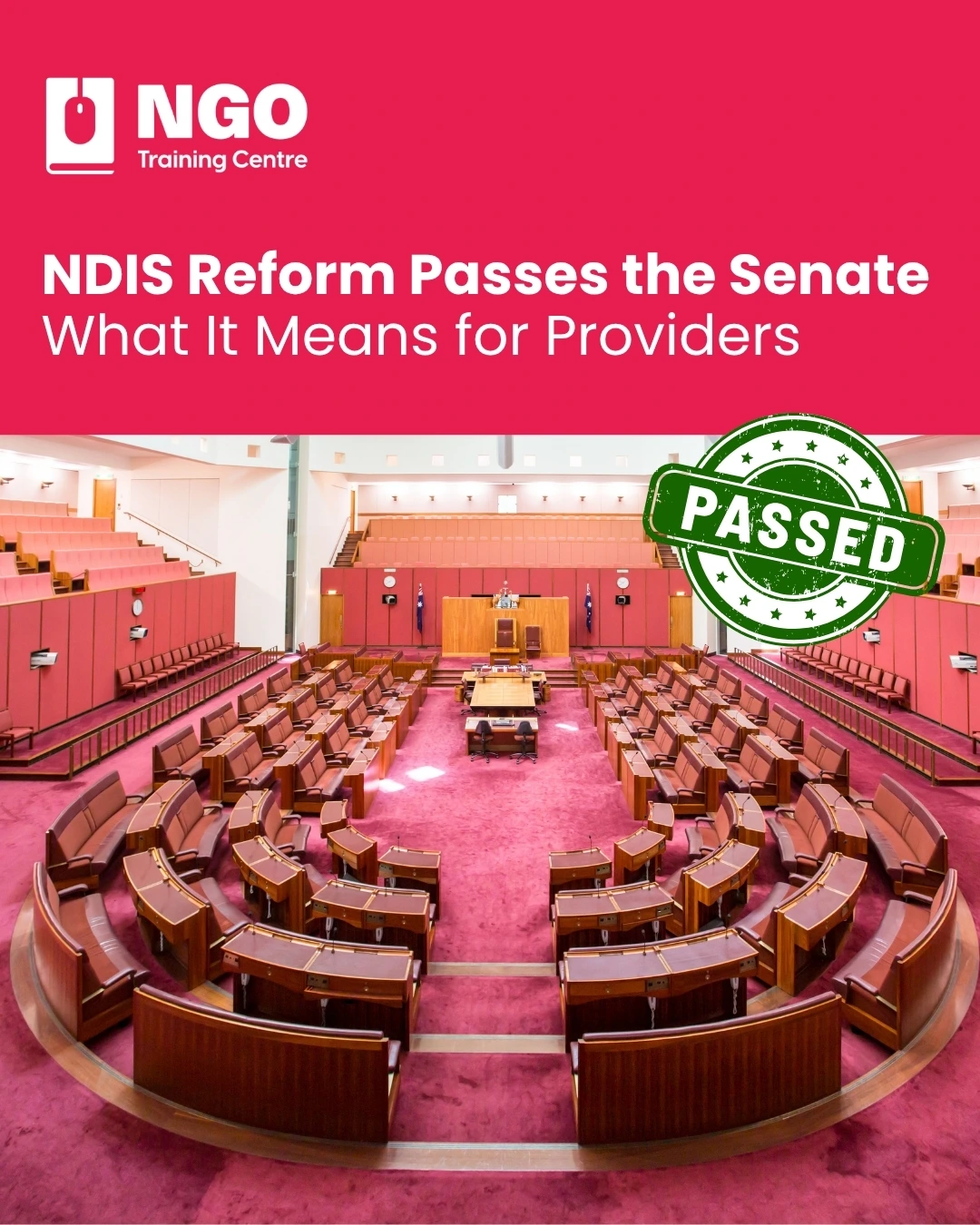
    Well, it’s happened. On 18 August 2026, the Senate passed the federal government’s NDIS reform package, with the Coalition voting alongside Labor.

    The bill heads back to the lower house next, and it’s expected to sail through there.

    If you work in this sector, this is the biggest shake-up the scheme has seen since day one, so it’s worth understanding what’s actually changing – and what you need to do.

    So, what passed?

    Before the vote, Labor put forward 63 amendments, shaped by consultation with the disability community and other parliamentarians. The whole package is aimed at two things: keeping the scheme financially sustainable and cracking down on fraud.

    To put the numbers in perspective, the scheme currently costs more than $50 billion a year. These reforms are projected to save around $37.8 billion over four years, and participant numbers are expected to drop from roughly 760,000 to 600,000 by 2030.

    Health Minister Mark Butler didn’t hold back, saying the scheme had become a target for “shonks and sharp practice.” NDIS Minister Jenny McAllister took a more restrained tone, describing the goal as a scheme that’s strong, safe, sustainable, and holds public confidence.

    What Providers need to know

    Four things here affect you directly.

    First, there are new penalties for kickbacks. The legislation brings in criminal and civil penalties for providers who offer or accept them. Worth noting: this is a conduct offence, not just an administrative slap on the wrist.

    Second, the NDIA gets stronger enforcement powers. The Agency can now act faster against providers doing unsafe or unethical things, so expect a much shorter gap between a concern being raised and regulatory action following.

    Third, whistleblower protections are expanding. Workers who report misconduct get additional protection, which means your internal reporting culture is no longer just a nice-to-have. It’s a compliance issue.

    And fourth, there’s a new escalation pathway for high-risk participants. People needing 24-hour continuous care can apply for a plan variation, aiming to shield this group from support cuts.

    Thriving Kids and foundational supports

    Butler was upfront that there’s still plenty of work to do on foundational supports, both for children over eight and for adults leaving the scheme.

    He’s holding firm that Thriving Kids starts on 1 October, even though Queensland hasn’t signed up. He pointed the states back to the hospital funding agreement signed earlier this year, and to the commitments they made back in 2023. Expect some friction on this front for the rest of the year.

    Not everyone’s happy

    The Greens argue these changes end the NDIS as it was originally promised. Senator Jordon Steele-John put it bluntly, saying the two major parties had made a decision about disabled people without them at the table. Crossbenchers and disability advocates have called the reforms too far, too fast.

    None of that, though, changes what providers now need to get on with.

    Why this comes back to training

    Here’s the thing: enforcement is speeding up, and penalties are getting sharper. In that environment, your workforce’s capability is the control that really counts.

    Providers who can show current, role-specific training on conduct, reporting, and documentation will handle regulatory attention far better than those who can’t.

    That’s exactly what we do. NGO Training Centre builds audit-focused training for the disability and aged care sectors, aligned to the NDIS Practice Standards and the NDIS Code of Conduct.

    A few of our courses that speak directly to these reforms are:

    40-COMPLAINTS-AND-REPORTABLE-INCIDENTS - NDIS Disability Support Training Course Australia - NGO Training Centre
    5-EFFECTIVE-PROGRESS-NOTES - NDIS Disability Support Training Course Australia - NGO Training Centre
    18-NDIS-FOUNDATIONS - NDIS Disability Support Training Course Australia - NGO Training Centre
    If your organisation is reviewing its compliance training ahead of these changes, we’d love to help.

    –

    Author: Amanda Robinson (She/Her) BA, MMHealthPrac.
    Dja Dja Wurrung and Taungurung Country

    Amanda, Head of Learning and Development and an experienced specialist in NDIS and Aged Care, promotes capability and sustainability within the disability and health sectors. With over 15 years of experience, a Master’s in Mental Health Leadership and Management, and an MBA underway, she offers extensive expertise and personal insight as someone with lived experience of disability. A military veteran and dedicated carer of a veteran, Amanda advocates for Human Rights, striving to reduce stigma and eliminate barriers for those with disability and mental health challenges. She is enthusiastic about fostering strong stakeholder relationships through her advocacy, communication, strategic thinking, and analytical abilities.
    Contact our friendly and supportive team

      If you deliver SIL supports, there is one line in the new SIL Practice Standards that will shape your next audit more than any other: decisions are made by participants, not for them.

      It sounds simple. In practice, it is the hardest thing to evidence, because it is not a policy, a consent form or a signature at intake. It is what your workers do at 7am when someone changes their mind about the roster, and at 4pm when someone wants to catch the bus on their own.

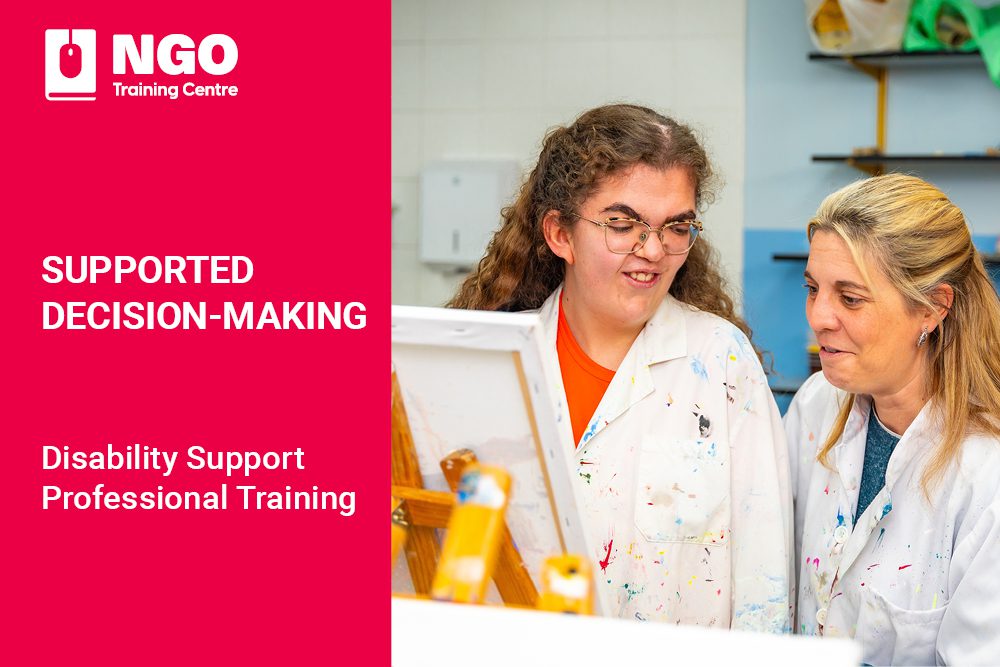
      That is exactly why we built our new course, Supported Decision-Making. And I will be honest with you: of everything we have released this year, this is the one I am most proud of.

      Why now?

      From 1st July 2026, SIL providers must be registered and must comply with the new SIL Practice Standards, adopted as a supplementary module that sits alongside the Core NDIS Practice Standards, not instead of them. You have to meet both.

      The new module was co-designed. The NDIS Commission worked with Inclusion Australia and with people with disability to develop it, and tested it in real audit settings before it was finalised. That co-design shows: supported decision-making is the first outcome in the module, and the emphasis has shifted from informed consent at intake to supported decision-making as an everyday practice.

      Which means an auditor is no longer only asking to see your policy. They are asking your frontline workers to describe how supported decision-making is applied, in their own words, about the people they actually support. That knowledge does not come from a briefing the week before audit. It comes from training, and from teams talking about it regularly.

      What is in the course?

      Supported Decision-Making takes about 35 minutes, is fully narrated, and is built around four learning objectives:

      • What supported decision-making is. The supported, shared and substitute framework, and why every person has the right to make decisions about their own life, their supports and the risks they are willing to take.
      • Communication and accessible information. Supporting each person to receive information and communicate in their preferred language and style, with practical tools: decision-making profiles, will and preference planning templates, decision-making flowcharts and communication access checklists.
      • Dignity of risk and informed decisions. Helping people weigh benefits and risks, and balancing duty of care with a person’s right to take reasonable risks.
      • Applying it in day-to-day practice. Recognising when more support is needed, understanding the recognised decision-support roles, and building a person’s decision-making skills over time.

      We also offer our sincere thanks to Lusie Glogovac, Aged Care and Disability Consultant and Registered Nurse, for her expertise in developing this course.

      103 SUPPORTED DECISION MAKING COURSE - CONTROL AND OUTBREAK MANAGEMENT PART 1 - NGO Training Centre NDIS Disability Support Training Course Online

      How it lines up with the new SIL Standards

      The supported decision-making outcome asks you to show that people living in a SIL arrangement understand their right to make decisions about their daily life, routines, relationships and their home, and that they actually exercise that right. The course speaks directly to that, and it does it the way auditors and workers both need: through practice, not theory.

      There is a SIL scenario in the course where:

      • David wants to move out of his shared SIL home into a quieter one-bedroom place near a park.
      • His support coordinator helps him explore options, costs, visual aids and inspections, and David chooses.
      • The course then names the alternative plainly: if the coordinator had decided the SIL home was better value and therefore better for David, supported decision-making would have been non-existent.

      That is the distinction the new module is built on, and it is the one your team needs to be able to articulate.

      There is also Maria, who lives in SIL accommodation, uses a communication board and needs time to respond, facing a roster change. This is the exact everyday moment the standard is aimed at. And because so many of our customers run combined workforces, the course covers aged care too: the new model for supported decision-making under the Aged Care Act 2024, registered supporters, and what to do when a supporter speaks over the person they are meant to be supporting.

      Every scenario ends the same way: what you observed, what the person said in their own words, what you did, and who you told. Which is, conveniently, exactly what evidence looks like.

      What I would do now

      • Map your workforce. Every worker delivering SIL supports needs supported decision-making training, not just team leaders.
      • Train before your next audit, not before your audit date is confirmed. Mid-term audits count.
      • Check your evidence trail. If your progress notes do not show how a person’s will and preferences guided a decision, the practice is invisible, no matter how good it was.
      • Give your team the language. Workers who can explain presuming capacity, will and preference, and dignity of risk in plain words are your strongest audit asset.

      Enrol your team or talk to us

      Supported Decision-Making is available now as an individual course, as part of our SIL Pathway and within our Disability and Aged Care training packages, with completion records and certificates in your LMS dashboard for audit evidence or provided at the end of the course. Existing customers will already see it in their course library.

      Join our Webinar

      NGO Training Centre Webinar - SIL Standards and NDIS Reforms - August 2026

      The NGO Training Centre is also hosting a Webinar on 27 August 2026, where you will hear about the requirements for registration, online self-assessment and you will hear directly from an NDIS and Aged Care Auditor, Marguerite Hoiby, who will be joining us in the session.

      This isn’t just another webinar full of slides. It’s your chance to hear directly from industry experts and get answers to the questions that matter most to your organisation.

      Have a question about the SIL reforms? Registration? Audits? Staff training? Evidence?

      Please send it through before the webinar! Simply register for the webinar, and add your question in the field provided.

      We’ll be answering as many pre-submitted questions as possible during the session, giving you practical advice you can take straight back to your organisation.

      Can’t attend live?

      No worries!

      Register anyway and send us your questions. We’ll record the webinar and share the recording afterwards, and we’ll do our best to cover every question, even if you can’t join us live.

      The NDIS is changing quickly. This is your opportunity to get practical guidance from three experts who work with providers every day, and leave with greater confidence about what comes next. We’d love to see you there!

      If you are unsure where your team sits against the new SIL Standards, talk to us or join in on our upcoming webinar. It is a short conversation and it is far cheaper and less time-consuming than a corrective action.

      We’ve got you covered.

      –

      Author: Amanda Robinson (She/Her) BA, MMHealthPrac.
      Dja Dja Wurrung and Taungurung Country

      Amanda, Head of Learning and Development and an experienced specialist in NDIS and Aged Care, promotes capability and sustainability within the disability and health sectors. With over 15 years of experience, a Master’s in Mental Health Leadership and Management, and an MBA underway, she offers extensive expertise and personal insight as someone with lived experience of disability. A military veteran and dedicated carer of a veteran, Amanda advocates for Human Rights, striving to reduce stigma and eliminate barriers for those with disability and mental health challenges. She is enthusiastic about fostering strong stakeholder relationships through her advocacy, communication, strategic thinking, and analytical abilities.
      Contact our friendly and supportive team

        NGO Training Centre Online NDIS Training
        Trigger Sidebar Cart0
        ×
        Your cart is empty. Return Home